
Professional tree pruning removes dead, diseased, or structurally weak branches using proven techniques that promote healthy growth patterns and reduce stress on the tree. Proper pruning improves airflow through the canopy, redirects energy to productive limbs, and prevents the spread of pathogens. Strategic cuts made at the correct locations and times strengthen the entire structure while extending the tree’s productive lifespan by decades.
Why Trees Require Regular Structural Maintenance
Trees growing in natural forest environments self-prune through competition and environmental pressures. In residential and commercial landscapes, trees lack these natural forces and develop structural weaknesses over time. Branches grow too close together, creating weak unions. Limbs extend too far horizontally without adequate taper. Co-dominant leaders split the trunk into competing growth patterns that eventually fail under wind or ice loads.
Regular maintenance addresses these issues before they become hazards. Removing competing leaders while the tree is young establishes a single dominant trunk. Thinning crowded branches allows the remaining limbs to develop proper thickness ratios. Shortening overextended branches reduces leverage forces that cause breakage during storms.
How Pruning Cuts Trigger Growth Responses
Every pruning cut changes how a tree allocates resources. When you remove a branch tip, you eliminate apical dominance from that shoot. Dormant buds below the cut receive more auxin and cytokinin hormones, triggering new growth. The location of your cut determines where this new growth emerges and in what direction it grows.
Cuts made just outside the branch collar preserve the tree’s natural defense zone. The collar contains specialized cells that compartmentalize wounds and prevent decay from spreading into the trunk. Flush cuts that remove the collar destroy this barrier and invite rot. Stub cuts that leave excess wood beyond the collar create dead tissue that pathogens colonize before the tree can seal the wound.
Timing Cuts to Match Tree Biology
Different species respond best to pruning at specific times. Most deciduous trees tolerate pruning during dormancy when energy reserves are stored in roots and trunk tissue. Late winter pruning, six to eight weeks before bud break, allows wounds to begin closing as soon as spring growth starts. This timing minimizes sap loss and reduces exposure to airborne pathogens.
Some species require different timing. Oaks should never be pruned during spring or early summer when oak wilt fungus spreads most actively through beetle vectors. Maples, birches, and walnuts bleed heavily if pruned in late winter, though this sap loss rarely harms the tree. Stone fruits require summer pruning to reduce bacterial canker infections that thrive in dormant-season wounds.
Crown Thinning Versus Crown Reduction Techniques
Crown thinning removes selected branches throughout the canopy to reduce density without changing the tree’s overall size or shape. This technique improves light penetration and air movement, which reduces humidity levels that promote fungal growth. Thinning also reduces wind resistance, allowing storms to pass through the canopy rather than pushing against a solid sail of foliage.
Crown reduction shortens branches back to lateral limbs large enough to assume the terminal role, typically at least one-third the diameter of the removed section. This technique reduces the tree’s height or spread while maintaining its natural form. Proper reduction cuts leave no stubs and redirect growth to appropriately sized laterals. Amateur topping cuts that leave large stubs create multiple weak shoots that grow rapidly and fail easily.
Removing Dead and Diseased Wood in Owego
Dead branches serve no function and pose falling hazards. They also provide entry points for wood-boring insects and decay fungi that spread into healthy tissue. Removing dead wood promptly prevents these problems from escalating. Diseased branches require removal several inches below visible symptoms to ensure you eliminate all infected tissue.
Sterilizing tools between cuts when working with diseased trees prevents spreading pathogens from infected to healthy branches. A 10% bleach solution or 70% isopropyl alcohol applied to blades between cuts kills most fungal spores and bacteria. This practice is essential when dealing with fire blight, anthracnose, or canker diseases that spread through contaminated tools. Our disease management services include proper sanitation protocols for all pruning work on infected trees.

Structural Pruning for Young Trees
The first five to seven years after planting determine a tree’s structural integrity for its entire life. Establishing a strong central leader and well-spaced scaffold branches during this period prevents expensive corrective work later. Remove competing leaders immediately, keeping the most vertical and vigorous shoot. Select permanent scaffold branches that emerge at 45 to 60 degree angles, spaced vertically along the trunk at intervals of 12 to 24 inches depending on species.
Temporary branches below the permanent scaffolds remain valuable for trunk development. These lower limbs produce hormones and carbohydrates that increase trunk caliper. Shorten them rather than removing them entirely, maintaining just enough foliage to support trunk growth without competing with scaffold branches. Remove these temporary limbs gradually over several years as the permanent crown develops.
Addressing Codominant Stems and Included Bark
Codominant stems form when two leaders of similar size grow upward from the same point, creating a V-shaped union. As these stems increase in diameter, bark becomes trapped between them rather than forming proper connective tissue. This included bark creates a weak point that often splits apart under load.
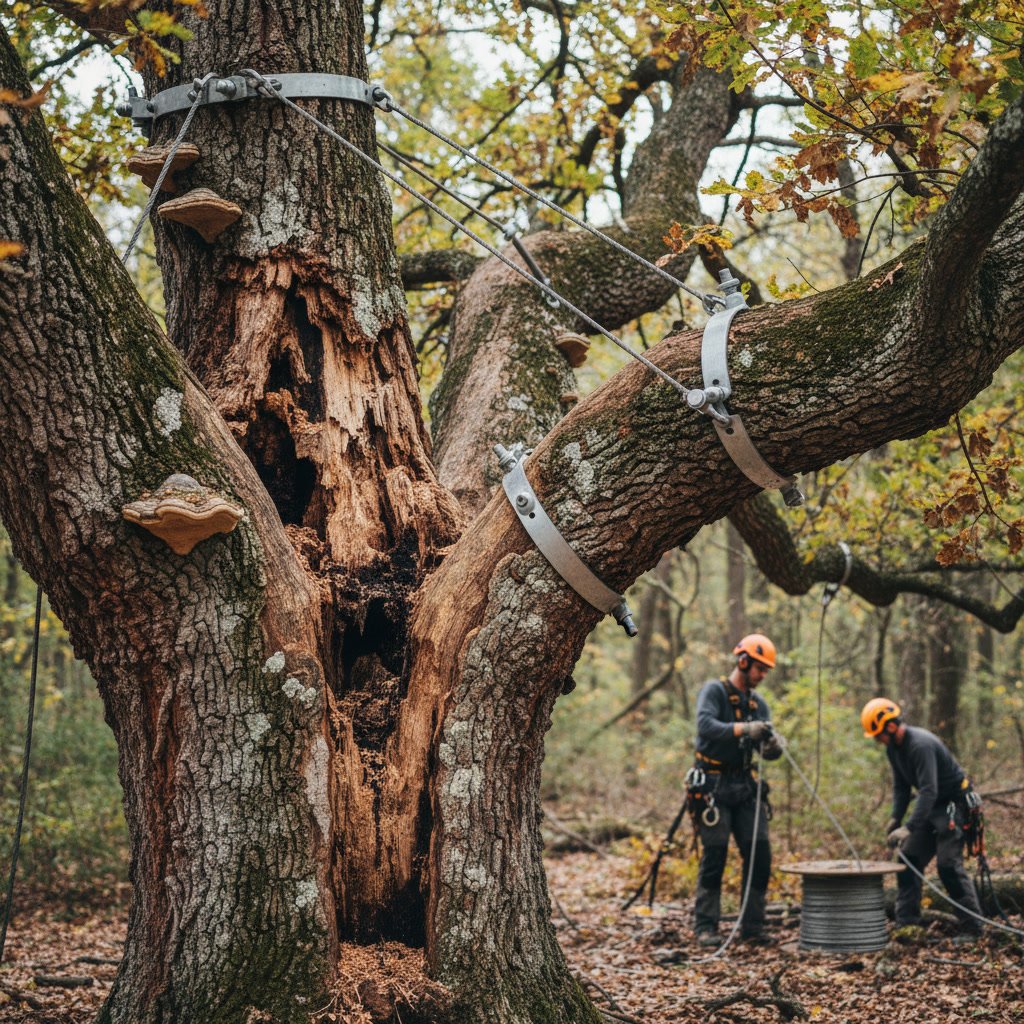
Subordinating one leader while it’s still small prevents this problem. Remove or shorten one stem to redirect growth energy to the remaining leader. For mature trees with established codominant stems, tree cabling or bracing systems provide structural support that prevents failure. Installing cables early, before decay starts at the weak union, offers the best protection.
Clearance Pruning for Safety and Access
Branches hanging over structures, power lines, or walkways require removal or shortening to maintain safe clearances. Utility companies typically require 10 feet of clearance around power lines, though this varies by voltage and local codes. Building clearances prevent roof damage from rubbing branches and reduce pest access to structures.
Clearance pruning follows the same principles as other pruning types. Make cuts at proper locations using appropriate techniques. Never top a tree to achieve clearance. Instead, remove entire limbs back to the trunk or shorten them to appropriate laterals. When clearance requirements exceed what proper pruning can achieve, tree removal becomes the safer option.
How Pruning Prevents Pest and Disease Problems
Dense canopies with poor air circulation create humid microclimates where fungal spores germinate easily. Thinning cuts that open the canopy allow sunlight and air movement to reduce leaf wetness duration, the critical factor in most foliar disease development. Removing branches that cross and rub prevents bark wounds that serve as infection courts.
Certain insects prefer stressed or damaged trees. Proper pruning reduces tree stress by eliminating damaged tissue and improving resource allocation. Healthy, vigorous trees produce defensive compounds that deter many pests. When problems do develop, targeted treatments through insect management programs work more effectively on properly structured trees with good air circulation.
Long-Term Benefits of Consistent Pruning Programs
Trees receiving regular pruning every three to five years develop stronger structures, live longer, and require less corrective work than neglected trees. Early intervention costs less than emergency removals after storm damage. Properly maintained trees add more value to properties and create fewer liability concerns.
Consistent maintenance also builds a relationship with your trees. You notice changes in growth patterns, early disease symptoms, or developing structural issues before they become critical. This familiarity allows for proactive management rather than reactive crisis response. Photographic records taken during each service document changes over time and guide future decisions.
Ensuring Your Trees Thrive for Decades
Strategic pruning done at the right times using proper techniques transforms how your trees grow and function. Removing problematic branches redirects energy to productive growth. Opening dense canopies prevents disease while improving form. Correcting structural defects early prevents catastrophic failures later. These benefits compound over years into healthier, safer, more valuable landscape trees.
TEK 22 Tree Service provides expert pruning services throughout Binghamton and surrounding areas. Our certified arborists understand tree biology and make cuts that work with natural growth patterns rather than against them. Whether you need structural pruning for young trees, maintenance pruning for mature specimens, or corrective pruning to address existing problems, we bring the knowledge and equipment to handle trees other companies consider too difficult or dangerous. Reach out at +16072375153 to schedule an assessment and learn how proper pruning will improve your trees’ health and longevity.